
SUCCESS STORY

Optimizing the impact of drive-to-store messaging with Eram thanks to RCS

Or how to - at last - prove the effectiveness of RCS using an incremental measurement approach

Numberly, a recognized expert for over 25 years in CRM, activation, and data science, supported Éram in implementing innovative solutions for smarter and more effective marketing.

In this context, Éram and Numberly have been collaborating for over ten years through a strong partnership, carrying out numerous projects aimed at enhancing customer understanding and improving campaign performance. More recently, a test of the RCS (Rich Communication Services) protocol was conducted for the Éram brand, allowing exploration of new forms of interactive and personalized communication.

Encouraged by the very positive results, the RCS protocol is now being extended to other brands within the group, including Mellow Yellow and Bocage.
The challenge

The SMS channel has nothing left to prove in terms of its relevance and effectiveness in generating drive-to-store behaviors.

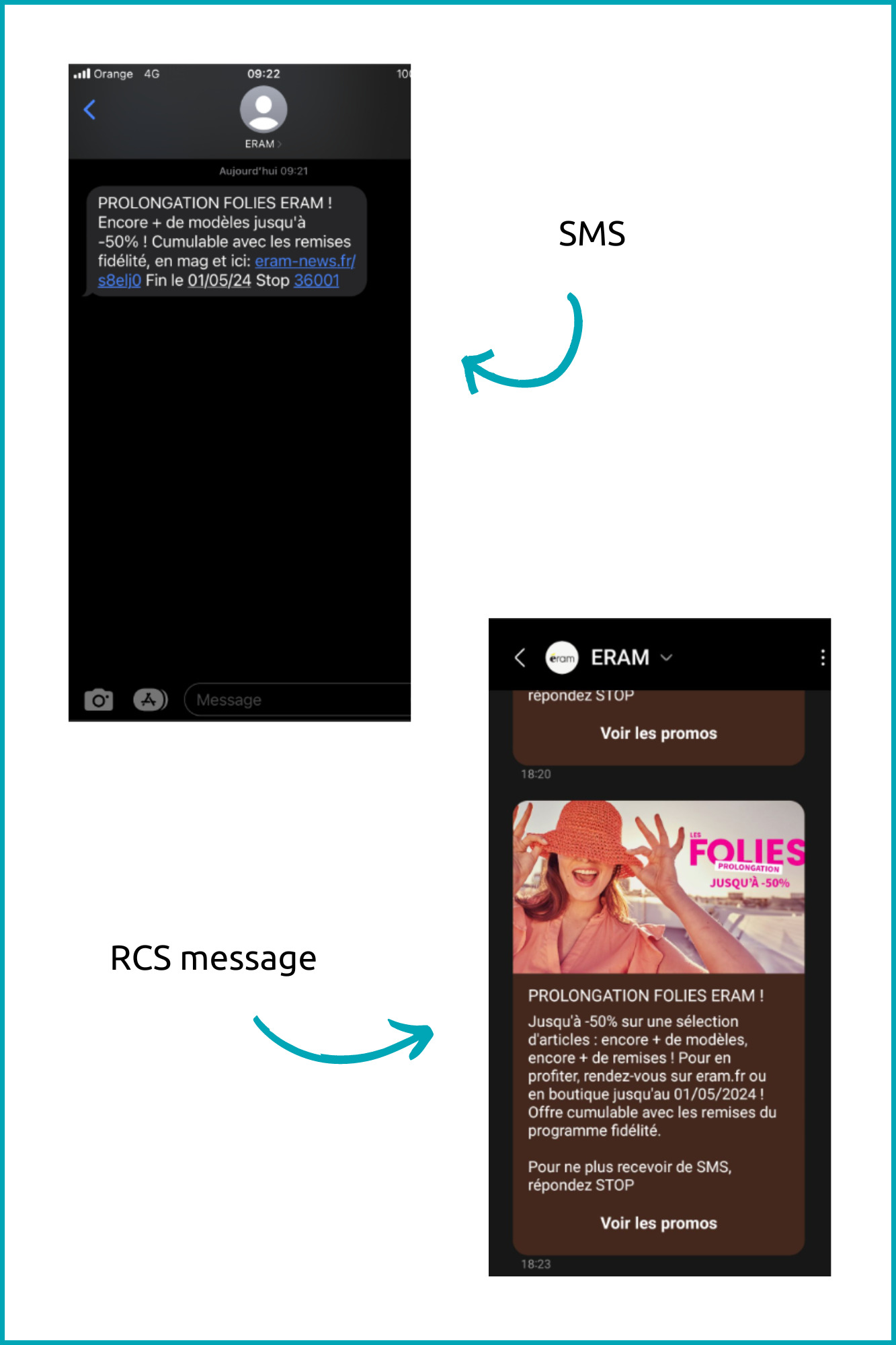
RCS (Rich Communication Services) is an attractive opportunity to consider: in fact, this format gives brands much more room for expression by capitalizing on the functionalities offered by smartphones. It enables to send photos or videos, or integrate a carousel… in order to optimize user engagement.

Today, RCS is gradually establishing itself as a key communication channel for brands. Its coverage has expanded significantly, making the service now accessible to the majority of Android users, while deployments on iOS are opening up new opportunities.

The added value in terms of engagement, conversion, and brand image makes it a promising strategic lever for relationship marketing campaigns.

The challenge for ERAM in this project was to gather granular learning on the performance and profitability of this new conversational channel.

The solution

We conducted an A/B test across multiple target groups to compare the incremental impact of RCS versus SMS, while carefully controlling for selection bias — that is, performance differences arising from the fact that RCS-compatible and non-compatible populations are not entirely identical.

This allowed us to test the RCS channel end-to-end, from message creation to delivery, and to precisely evaluate the benefits of this channel on customer engagement.

4 populations were targeted during a promotional event:

  • Churners
  • Good and very good customers
  • Newly-reactivated via email
  • Possible churners

Each of the 4 populations was therefore subjected to a RCS canal eligibility test:

  • Individuals with non-RCS-compatible devices received a text message
  • Individuals with an RCS-enabled device were randomly divided into two subgroups: half received an RCS message, half an SMS

In addition to engagement data differentiated by customer segment, we can precisely measure the number of buyers and sales directly attributable to RCS.

The results

We have also analyzed the impact according to the different targets, which allows us to highlight the following learnings:

  • On churners: the best impact, with an incremental ROI of over 10
  • On good and very good customers (who represent a broader target): RCS is also very profitable.
  • On the specific target of newly email-reactivated customers: we note no significant impact. In fact, the change of channel (whether SMS or RCS) is sufficient for conversion, with no need to enrich the format via RCS.

97%

Rate of successful messages

X2

Higher click-through rate than Rich SMS messages

+29 %

Higher conversion rate than SMS

"This first step in measuring the profitability of RCS makes us want to go much further, by rolling it out on our upcoming promotional highlights, and exploring its richness for branding actions."

Discover the case in video! (subtitles available in English)